1
Complex analysis is the study of holomorphic functions on open subsets of
bookAhlfors - Complex analysisbookStein and Sakarchi - Complex analysislecture videosChristopher Bishop - MAT 536, Complex Analysis I, Spring 2024
After a first course on complex analysis, we can move onto functional analytic techniques. Using such tools we can prove the Riemann mapping theorem.
bookConway - Complex analysis I, Chapter 6, 11, 12lecture notesTao - 246A, Notes 5: conformal mapping
There some some number theoretic results that we can prove using the theory of holomorphic functions.
We can do even more functional analysis with holomorphic functions. We can ask: what does holomorphic images of disks look like? How large or small can they be? Do they contain a disk of some fixed radius?
bookConway - Complex analysis IIlecture notesTao - Holomorphic images of diskswikipediaConformal radius - Wikipedialecture notesTao - 246C notes 3: Univalent functions, the Loewner equation, and the Bieberbach conjecture | What’s new
One may study a generalization of conformal maps, called quasiconformal homeomorphisms. We can prove results about them similar to holomorphic maps. Using this theory, we can produce an explicit sequence of maps that converge to the Riemann mapping as in the Riemann mapping theorem.
lecture notesTao - 246C notes 2: Circle packings, conformal maps, and quasiconformal maps | What’s newlecture notes, videosChristopher Bishop - MAT 627, Topics in Complex Analysis: quasiconformal mappings
We can even look at connections to random processes, fractals and so on.
lecture notes, videosMcMullen - From Conformal Invariants to Percolation, From conformal invariants to percolation - YouTubelecture notes246C notes 4: Brownian motion, conformal invariance, and SLE | What’s newlecture videosChristopher Bishop - MAT 627: Topics in Complex Analysis: Conformal Fractals, Spring 2022lecture videosChristopher Bishop - MAT 639, Topics in Real Analysis: Harmonic measure
2
Riemann surfaces are connected complex 1-manifolds. Compact Riemann surfaces are same as
bookForsterbookMirandabookWilhelm Schlaglecture videoson Riemann Surfaces by M Khalkhali with videos on YouTubebookDonaldsonbookJost
There are alternative ways to define Riemann surfaces: the nicest of which is as the ringed space of functions locally isomorphic to open subsets of
lecture noteshttps://mathweb.tifr.res.in/~srinivas/rsfull.pdf (uses ringed spaces definition of Riemann surfaces where the rings are rings of functions on it)lecture noteshttps://math.berkeley.edu/~teleman/math/Riemann.pdf
And there are many more references… a hundred more books and notes available online https://mathoverflow.net/questions/313254/references-for-riemann-surfaces.
Standard texts prove the monodromy theorem for analytic continuations. However, that just says when two such continuations are bound to be the same. We don’t have any result about existence of analytic continuations. Why?
It is because they may behave very weirdly.
We however know what is the maximal extent of analytic continuations. Riemann asked this question originally. Ahlfors has the Etale space definition of domain of global holomorphic functions. Forster denotes this as
- ??
We can look at examples of such global domains of functions/gems of functions such as
Alright, we dealt with algebraic functions that satisfy a polynomial with coefficients in the field of meromorphic functions. What other holomorphic germs can we deal with? How about the elliptic integral
where
First, we can construct their Riemann surface. Forster does this, even for higher degree polynomials hyperelliptic integrals.
Second, we can try to ask what’s the “inverse” of the function defined above. There is a nice answer to this! Its the Weirstrass elliptic function
Period of an elliptic curve uniquely reconstructs it as a Riemann surface. However, doing this with compact Riemann surfaces of genus higher than one is a bit tricky. Equivalent question is how may we “invert” integrals of the form
where
bookComplex Analysis 2: Riemann Surfaces, Several Complex Variables, Abelian Functions, Higher Modular Functions | Springer Nature Link Chapters 4 to 7
The works of Abel and Jacobi shows that we can think of these integrals as holomorphic 1-forms on compact Riemann surfaces
The theorem of Torelli shows that the period of a higher genus compact Riemann surface also reconstructs it uniquely.
This chain of thought somehow leads us to Hodge theory.
The uniformization theorem for Riemann surfaces state that any simply connected Riemann surface is biholomorphic to either
lecture videosRiemann Surfaces by Jacob Bernstein for MSRI summer school 2014: Complex geometry and geometric analysis on complex manifolds ^yg7hmg- Prerequisites:
- Knowledge of basic complex analysis—at the level of Ahlfors, Complex Analysis, Chapters 1-5—will be assumed. Some basic familiarity with (abstract) surface theory and differential forms will be helpful. However, I will review this material as needed.
- Reading:
- The main text will be Donaldson - Riemann Surfaces.
- Syllabus
- Other useful references:
- Farkas and Kra, Riemann Surfaces; a classical text on the subject.
- Miranda, Algebraic Curves and Riemann Surfaces; a more algebraic perspective.
- Week 1: Introduction to Riemann Surfaces
- Surfaces and Topology
- Riemann Surfaces and Holomorphic Maps
- Maps between Riemann Surfaces
- Calculus on Riemann Surfaces
- De Rham Cohomology
- Week 2: Geometric Analysis on Riemann Surfaces
- Elliptic Functions and Integrals
- Meromorphic Functions
- Inverting the Laplacian
- The Uniformization Theorem
- Riemann Surfaces and Minimal Surfaces
- Prerequisites:
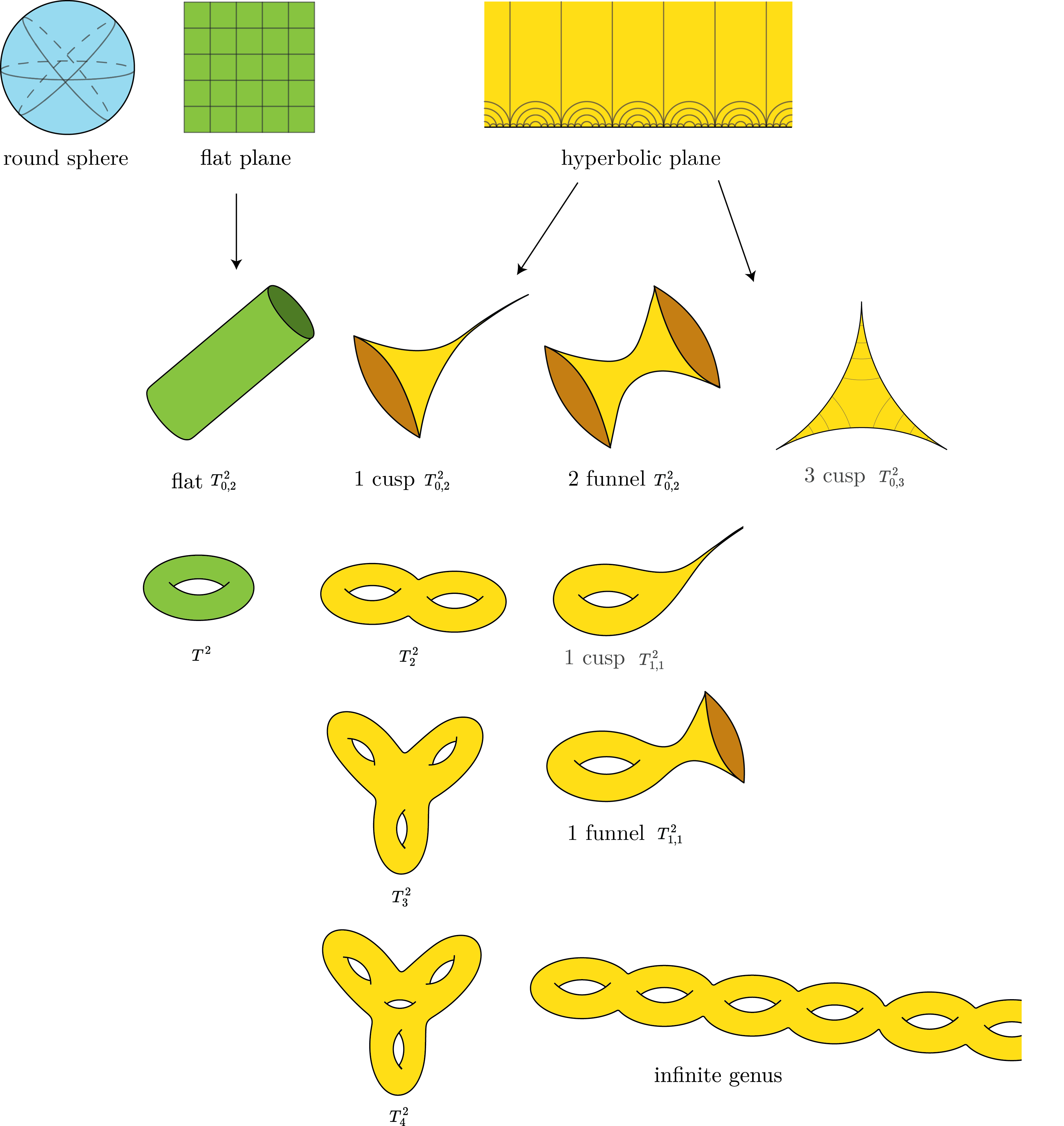
By the uniformization theorem, every Riemann surface is a quotient of
lecture videosThese lectures assume covering space theory (algebraic topology) and uniformization theory and does (pre-moduli space) classification of Riemann surfaces: https://www.youtube.com/playlist?list=PLbMVogVj5nJSm4256vuITlsovUT1xVkUL
Riemann surfaces which are quotients of the unit disk by torsion free Fuchsian groups are biholomorphic if and only if the Fuchsian groups are conjugate inside the automorphism group of the unit disk. Oriented hyperbolic surfaces (connected, complete Riemannian 2-manifolds of constant sectional curvature -1) are also quotients of the unit disk by torsion free Fuchsian groups, with oriented isometries related to conjugacies. Therefore we may study, even classify Riemann surfaces through the theory of oriented hyperbolic surfaces.
The space of all marked Riemann surfaces of genus
bookFarb Margalit - Mapping class groups
3
We can consider the algebraic perspective to Riemann surfaces.
talkAlgebraic Curves and Belyi’s theorem by Anand Deopurkar - YouTubelecture videosMAT 670: Topics in Complex Analysis: Dessins and Dynamics (introduction to quasiconformal folding)
We may define a weaker notion of isomorphism of Riemann surfaces: quasiconformal homeomorphism. The class of marked Riemann surfaces quasiconformal to a fixed Riemann surface generalise the Teichmuller space of compact Riemann surfaces.
bookHubbard - Teichmuller theory volume 1
A hyperbolic surface comes with its Laplacian. We may study its spectrum and eigenfunctions and ask interesting questions!
bookGeometry and Spectra of Compact Riemann Surfaces - Google Booksbookarithmetic quantum unique ergodicitylecture videosChristopher Bishop - MAT 638: Topics in Real Analysis: Weil-Petersson curves, traveling salesman theorems, and minimal surfaces, Fall 2020
We may study the spectral theory of modular surfaces and extract number theoretic facts.
paperhttps://web.math.princeton.edu/~sarnak/Preprints/baltimore.pdflecture notesLectures on Diophantine approximation and Dynamics
We can ask questions about moduli of Riemann surfaces, such as its spectra as genus goes to infinity and so on.
We can compactify the moduli space.