This list was made with materials found on the internet (mostly freely available), to reduce my pain of searching each time they are needed. All opinions, arrangements, organizations etc are strictly mine. Because of that, this list lacks topics like number theory, algebraic geometry, graph theory, algorithms, combinatorics, etc.
This list was recently (August ‘26) revamped!
I
We start with groups, vector spaces and metric spaces.
finite groups
The miniseries Essence of Group Theory - YouTube carries it forward.
vector spaces
We see with just the “little” definition of a vector space, we can have things like writing any vector as a unique linear combination of finitely many vectors from a smaller subset of the entire space. This much of structure is enough to ask a lot of questions and a solve a whole lot of problems! If you want more things, we can have more things! (oriented vector space, inner product spaces, normed vector spaces, etc.).
lectures, bookLinear Algebra Done Right - Sheldon Axlerlecture videosLinear Algebra by Dr. K.C. Sivakumar
Need help proving stuff? Try following the arrows to prove equivalent conditions for injectivity of linear maps on finite dim spaces:

metric spaces
real analysis I
Napkin
Evan Chen’s A Infinitely Large Napkin is an introduction to a lots of fields of math! However, it is NOT a textbook but a really nice introductory reference. It starts with groups and metric spaces!
The Prinston Companion to Mathematics
The Princeton Companion to Mathematics
history of mathematics
lecture videos MathHistory: A course in the History of Mathematics (although be aware, the instructor doesn’t believe that
handwavy physics
We learn physics though the Action principle.
Ignore the Fourier expansion of electric field stuff, just the ideas behind GR, QFT matters! Continue with GR and action: General Relativity by Prof. Thanu Padmanabhan - YouTube.
After that watch these lectures covering Newtonian, Lagrangian, Hamiltonian mechanics, statistical mechanics, special relativity all at once!
These are nice as an intro “proper” physics, they will look fascinating, but my recommended levels of motivation and precision is absent. These are “Feynman lectures done right”. One may watch his non-linear dynamics and quantum mechanics lectures right after this. But nothing is explained “rigorously”, although hinted at, lots of details are skipped and Balki name drops a LOT of stuff. You may choose to ignore them initially, because each term becomes a rabbit hole for math topics.
Going ahead, we can look at quantum physics.
For more mechanics one may look at
and
bookSteven Strogatz - Nonlinear dynamics and chaos : with applications to physics, biology, chemistry, and engineering
II
We continue with algebra, analysis, topology and geometry.
rings and modules
Looking back on linear algebra, we can reiterate the following.
A
I am still looking on how to understand two linear endomorphisms giving a
Let’s say we have a
representation theory of finite groups
A group homomorphism from a (say, finite for now) group
is called a representation of the group
cute topology
Visualizing higher dimensions
The meme is
> attend a string theory conference
— ricky (@rickyflowsinyou) July 22, 2023
> speaker keeps mentioning 10d space
> can't visualize and am completely lost
> mathematician beside me seems to understand
> ask him, how do you visualize 10d space?
> it's easy anon, first picture N-dimensions and then set N = 10 pic.twitter.com/Sg87emdUuYA mathematician’s reply is
Most mathematicians can visualize N dimensions for N a positive integer, or infinite, and in some cases a positive fraction.
— Algebraic Geometer (@BarbaraFantechi) July 23, 2023
I can do it for N integer but negative. https://t.co/6WnxMZVT6JWhat I do is simply follow
- step 0: Picture 1, 2, 3 dimensional vector spaces
- step 1: Write
instead of 1, 2 or 3 (imagine n=1,2 or 3 but don’t write it down, only use n) whenever I am generalizing. Note if we never use the fact that or , i.e. we write all the time etc, pretend we’re working with a natural number but visualize only 2 or 3 dimensions then our work is done: we have “visualized dim ”, by simply forgetting or , yay!
- step 2: put
whatever natural number you like! That’s what a first semester course on linear algebra is supposed to do initially (after defining the “dimension” of a vector space). This is the algebraic way to visualize things: using symbols!
There’s a next step for doing functional analysis type stuff:
- step 3: Don’t even think about n being a natural number anymore, it can be infinite.
This doesn’t help much working with infinite dimensional vector spaces, but alright!
We can generalize “dimension” and “spaces” to things beyond vector spaces: they are called “manifolds”. There are many “different” manifolds of a fixed dimension even: a circle and
(real line) are both manifolds of dimension 1, or “1-manifolds”. 2-manifolds are just surfaces: 2-sphere, torus, etc.
is a 3-manifold, so is the “solid ball” 3-ball. i think that genus 1 is mischievous pic.twitter.com/FWjsJYcRyD
— chiara travesset (she/her) (@chairtraveler) February 10, 2023We can’t even all 3-manifolds like the 3-torus, 3-sphere (the sphere that lives in
) etc. But I can visualize the 3-sphere upto removal of just a tiny a point! The joke/reason being 3-sphere minus a point is just
or 3-ball (just like how the usual 2-sphere minus a point is just the disk or “2-ball”). Link to originalOH GOD WHO GAVE HIM A KNIFE pic.twitter.com/niGRQjRDvs
— chiara travesset (she/her) (@chairtraveler) February 10, 2023
- how topology affects and interacts with geometry, analysis, algebra (Lie groups, say) and physics
curves and surfaces
bookdo Carmo - Differential geometry of curves and surfaceslecture videosICTP Diploma - Differential Geometry - Claudio Arezzo - YouTube These lectures has pre-requisites of basic linear algebra, analysis in, knowing total derivatives and bilinear forms with introducing yourself a little topology (compactness, connectedness).
probability and information theory
illustrations in mathematics
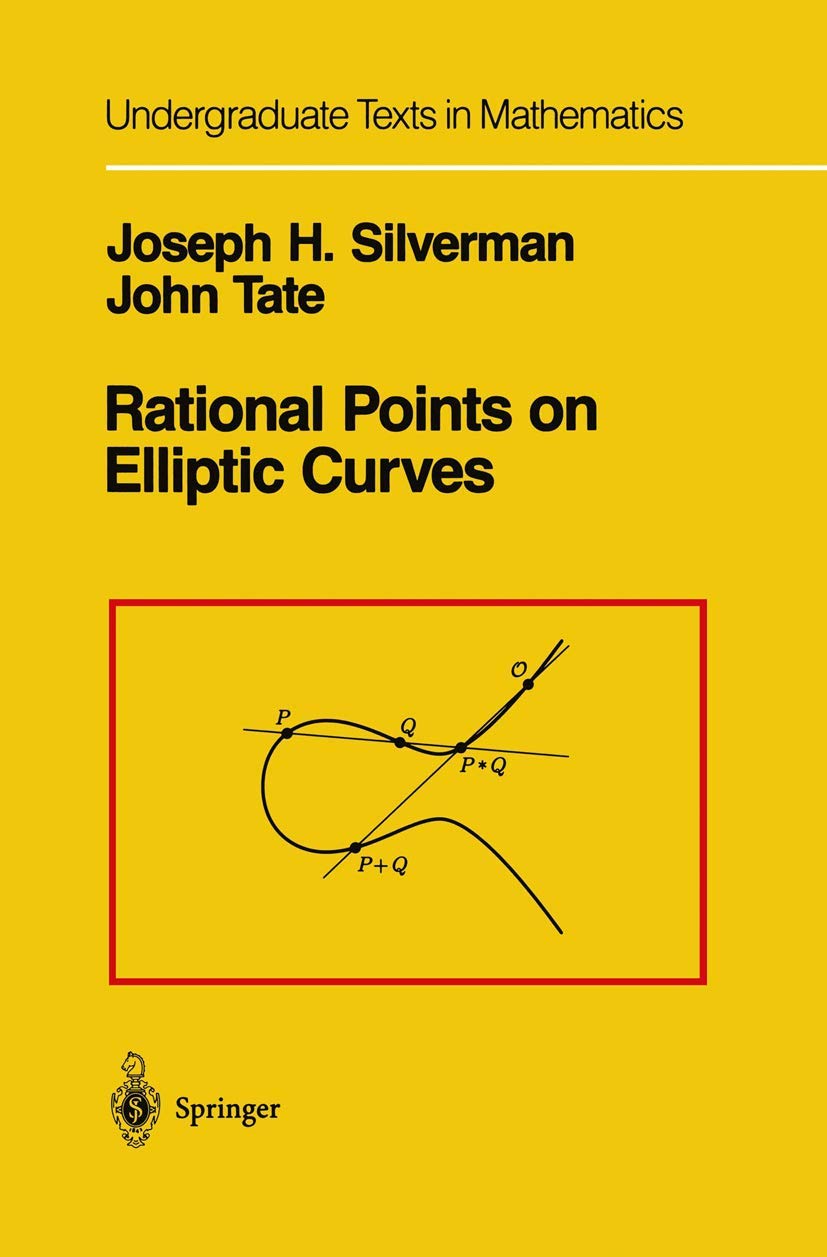
elementary algebraic geometry and number theory
III
Life and mathematical adventure is very nonlinear, but arguments should not be circular. We linearly construct from the ground up to have a stronger foundation for mathematics.
logic
set theory
real analysis II
Total derivative of function
between finite-dim real normed vector spaces at a point
that “approximates”
should “look” like a rotation “near
- Analysis by Herbert Amann and Joachim Escher Volume I
complex analysis
1
Complex analysis is the study of holomorphic functions on open subsets of
.
bookAhlfors - Complex analysisbookStein and Sakarchi - Complex analysislecture videosChristopher Bishop - MAT 536, Complex Analysis I, Spring 2024After a first course on complex analysis, we can move onto functional analytic techniques. Using such tools we can prove the Riemann mapping theorem.
bookConway - Complex analysis I, Chapter 6, 11, 12lecture notesTao - 246A, Notes 5: conformal mappingThere some some number theoretic results that we can prove using the theory of holomorphic functions.
We can do even more functional analysis with holomorphic functions. We can ask: what does holomorphic images of disks look like? How large or small can they be? Do they contain a disk of some fixed radius?
bookConway - Complex analysis IIlecture notesTao - Holomorphic images of diskswikipediaConformal radius - Wikipedialecture notesTao - 246C notes 3: Univalent functions, the Loewner equation, and the Bieberbach conjecture | What’s newOne may study a generalization of conformal maps, called quasiconformal homeomorphisms. We can prove results about them similar to holomorphic maps. Using this theory, we can produce an explicit sequence of maps that converge to the Riemann mapping as in the Riemann mapping theorem.
lecture notesTao - 246C notes 2: Circle packings, conformal maps, and quasiconformal maps | What’s newlecture notes, videosChristopher Bishop - MAT 627, Topics in Complex Analysis: quasiconformal mappingsWe can even look at connections to random processes, fractals and so on.
lecture notes, videosMcMullen - From Conformal Invariants to Percolation, From conformal invariants to percolation - YouTubelecture notes246C notes 4: Brownian motion, conformal invariance, and SLE | What’s newlecture videosChristopher Bishop - MAT 627: Topics in Complex Analysis: Conformal Fractals, Spring 2022lecture videosChristopher Bishop - MAT 639, Topics in Real Analysis: Harmonic measure
Link to original
measure theory
topology
bookMunkres- http://www.math.toronto.edu/ivan/mat327/?resources
- http://math.iisc.ac.in/~gadgil/topology-2021/all-lectures/
- Topology (MTH-TOP) - YouTube
- For a quick one lecture introduction with motivation: Lecture 1: Topology (International Winter School on Gravity and Light 2015) - YouTube
- π-Base
Galois theory
algebraic topology I
bookHatcher’s textbooklecture videosAlgebraic Topology - Pierre Albin - YouTube
topological and geometric group theory
- Clara Loh - “Geometric Group Theory”
- Pierre de la Harpe - “Topics in Geometric Group Theory”
- Office Hours with a Geometric Group Theorist
smooth manifolds
lecture videosTMS 2024 Spring: Differential Forms in Algebraic Topologylecture videoshttps://www.math.iitb.ac.in/~ronnie/Fall2020/MA815.html
dynamics
This is more a “dynamical systems” course, but has ODEs too
And follows the notes
lecture notesSLI.pdf (bris.ac.uk)


bookArnold’s Ordinary Differential Equations is also a good resource.bookGerald Teschl’s book on ODEs and dynamical systems is amazing!
And move onto more dynamical systems
bookHasselblat and A Katok - A First Course in Dynamicslecture notesDr. Richard Brown Math 110.421, Dynamical Systems, Spring 2010****
everything in a dynamics pov
What is “dynamics”? A dynamical system, in general, is a monoid action on a set.
Ignoring the generality, let’s consider the definition of a discrete dynamical system: a function
on a set is considered to be a discrete dynamical system (autonomous) where the iterations of the map
are considered the time map for
. Thus orbit of a point is defined to be Simply put, just “iterations of a map” produces the dynamics.
Using this simple, extremely general definition, we reinterpret a lot of math in terms of “dynamics”:
- Linear algebra is study of iterations of one linear map on a vector space. The canonical forms essentially decomposes the dynamics into indecomposable pieces.
- Finite group theory studies group action on a (finte) set are by definition “dynamics”
- A module of a ring is just a special group action by the additive group of the ring which also plays well with the multiplicative structure. Representation theory in most cases studies such modules.
- There are various applications of theorems that are “dynamical”
- proof of existence of ODEs using contraction mapping theorem
- Solutions of an ODE (with unique solutions) on
produces a flow map on the phase space
that map initial conditions to solution curves (this is the definition). Thus this is a “continuous-time dynamics”. Link to original
- A common proof of existence of solutions to ODEs uses a fixed point theorem, which is in turn a “dynamical” theorem!
- Machines have a natural monoid action.
semi-Riemannian manifolds
geometric mechanics
Schuller’s lectures are a good place to start.
People have written up notes from these lectures: THE WE-HERAEUS INTERNATIONAL WINTER SCHOOL ON GRAVITY AND LIGHT (Spanish Translation Available!) (richie291.wixsite.com) and Maths with Physics: The WE-Heraeus International Winter School on Gravity and Light, Lectures, Tutorials and Solutions .
lecturenotesUse measure theory to do Classical Equilibrium Statistical Mechanics
PDEs
- Partial Differential Equations - Giovanni Bellettini - Lecture 01 - YouTube
talkMathematics of Turbulent Flows: A Million Dollar Problem! by Edriss S Titi - YouTube
symplectic manifolds
lecture videosFields Academy Course: Symplectic Geometry
computation in mathematics
IV
analysis
We start with some Functional analysis.
bookhttps://www.kryakin.site/am2/Stein-Shakarchi%5D-4-Functional-Analys.pdf- Papa and grandpa Rudin
lecture videosMIT 18.102 Introduction to Functional Analysis, Spring 2021lecture videosIMPA Doctorate program: Functional Analysis (2019)
Then look at some Fourier analysis.
bookM Pinsky - Introduction to Fourier Analysis and Wavelets (2009)lecture videos【MIT数学课程】傅里叶分析:18.103 Fourier Analysis: Theory and Applications Fall 2020_哔哩哔哩_bilibili
Some even more hard-core analysis.
lecture videos【MIT数学课程】 微分分析:18.155 Differential Analysis Ⅰ Fall 2020_哔哩哔哩_bilibililecture videos【MIT数学课程】 微分分析:18.156 Differential Analysis Ⅱ Spring 2021_哔哩哔哩_bilibili
ergodic theory
bookEinsiedler and Ward - Ergodic Theorylecture videosErgodic Theory, Geometry and Dynamics
ergodic theory and Lie groups
Link to original
Lie groups, Lie algebras and their finite dimensional representation theory
introductory
Link to original
- Lie Groups and Lie Algebras - YouTube
- Borcherds - Lie groups - YouTube
- Introduction to Lie Theory
- Short course on Lie Groups by M.S. Raghunathan - YouTube
bookFulton, Harris - Representation theory
Lie groups and Lie algebras
Link to original
- Introduction to Lie Groups (Fall 2020, ETHz)(部分)_哔哩哔哩_bilibili
- AIC - Compact Lie groups and their representations (2022)- Prof. M. S. Raghunathan, Centre for Basic Sciences, Mumbai - YouTube
- Unitary Representations of Lie Groups | ETH Zürich Videoportal
- Anupam Singh - AIS on Lie Algebras (4-23 July 2011) CMI-IMSc, Chennai (google.com)
- Introduction to Lie Algebras Doutorado IMPA Verao 2011 Reimundo Heluani 03/01/2011 aula 01 parte1 (youtube.com)
mechanics
bookGregory L. Naber - Topology, Geometry and Gauge fields - two volumesbookMikio Nakahara - Geometry, topology, and physics
algebraic topology II
bookMay - Algebraic topologylecture videoshttps://metaphor.ethz.ch/x/2022/fs/401-3002-12L/ Algebraic Topology II (Spring 2020)(部分)_哔哩哔哩_bilibililecture videosAlgebraic topology from a geometric perspective
symplectic dynamics
differential geometry
bookR W Sharpe, S S Chern - Differential Geometry Cartan’s Generalization of Klein’s Erlangen Program-Springer (1997)lecture videos【MIT数学课程】 黎曼几何:18.965 Geometry of Manifolds Ⅰ 2020 Fall_哔哩哔哩_bilibili
algebraic varieties
bookHarris - Algebraic geometry
commutative, homological and categorical algebra
Well…
more complex analysis, Riemann surfaces, algebraic curves, hyperbolic surfaces
2
Riemann surfaces are connected complex 1-manifolds. Compact Riemann surfaces are same as
-algebraic curves. We can study meromorphic functions and meromorphic forms on these spaces.
bookForsterbookMirandabookWilhelm Schlaglecture videoson Riemann Surfaces by M Khalkhali with videos on YouTubebookDonaldsonbookJostThere are alternative ways to define Riemann surfaces: the nicest of which is as the ringed space of functions locally isomorphic to open subsets of
.
lecture noteshttps://mathweb.tifr.res.in/~srinivas/rsfull.pdf (uses ringed spaces definition of Riemann surfaces where the rings are rings of functions on it)lecture noteshttps://math.berkeley.edu/~teleman/math/Riemann.pdfAnd there are many more references… a hundred more books and notes available online https://mathoverflow.net/questions/313254/references-for-riemann-surfaces.
Standard texts prove the monodromy theorem for analytic continuations. However, that just says when two such continuations are bound to be the same. We don’t have any result about existence of analytic continuations. Why?
It is because they may behave very weirdly.
We however know what is the maximal extent of analytic continuations. Riemann asked this question originally. Ahlfors has the Etale space definition of domain of global holomorphic functions. Forster denotes this as
. Its connected components actually exhaust the entire class of open Riemann surfaces (I think?).
- ??
We can look at examples of such global domains of functions/gems of functions such as
, or such fractional power of polynomials , and so on. These functions are roots of polynomials for example satisfies . Some people call such functions algebraic. Standard texts such as Forster talks about Riemann surfaces of algebraic functions, which are more generally roots of polynomials over meromorphic functions over a compact Riemann surface . Such functions have global domain a finite branched cover over . Alright, we dealt with algebraic functions that satisfy a polynomial with coefficients in the field of meromorphic functions. What other holomorphic germs can we deal with? How about the elliptic integral
where
. How may we describe these functions? Well there are two ways to talk about them. First, we can construct their Riemann surface. Forster does this, even for higher degree polynomials hyperelliptic integrals.
Second, we can try to ask what’s the “inverse” of the function defined above. There is a nice answer to this! Its the Weirstrass elliptic function
. Such elliptic functions are meromorphic on complex tori isomorphic to the elliptic curve defined by the polynomial . These are the periods of this elliptic curve. Period of an elliptic curve uniquely reconstructs it as a Riemann surface. However, doing this with compact Riemann surfaces of genus higher than one is a bit tricky. Equivalent question is how may we “invert” integrals of the form
where
is a polynomial of degree 5 or higher. The degree 3,4 case corresponds to the case of elliptic curves.
bookComplex Analysis 2: Riemann Surfaces, Several Complex Variables, Abelian Functions, Higher Modular Functions | Springer Nature Link Chapters 4 to 7The works of Abel and Jacobi shows that we can think of these integrals as holomorphic 1-forms on compact Riemann surfaces
and their inverses are functions on their Jacobian, a complex tori of dimension = genus of . The theorem of Torelli shows that the period of a higher genus compact Riemann surface also reconstructs it uniquely.
This chain of thought somehow leads us to Hodge theory.
The uniformization theorem for Riemann surfaces state that any simply connected Riemann surface is biholomorphic to either
, the unit disk or .
lecture videosRiemann Surfaces by Jacob Bernstein for MSRI summer school 2014: Complex geometry and geometric analysis on complex manifolds ^yg7hmg
- Prerequisites:
- Knowledge of basic complex analysis—at the level of Ahlfors, Complex Analysis, Chapters 1-5—will be assumed. Some basic familiarity with (abstract) surface theory and differential forms will be helpful. However, I will review this material as needed.
- Reading:
- The main text will be Donaldson - Riemann Surfaces.
- Syllabus
- Other useful references:
- Farkas and Kra, Riemann Surfaces; a classical text on the subject.
- Miranda, Algebraic Curves and Riemann Surfaces; a more algebraic perspective.
- Week 1: Introduction to Riemann Surfaces
- Surfaces and Topology
- Riemann Surfaces and Holomorphic Maps
- Maps between Riemann Surfaces
- Calculus on Riemann Surfaces
- De Rham Cohomology
- Week 2: Geometric Analysis on Riemann Surfaces
- Elliptic Functions and Integrals
- Meromorphic Functions
- Inverting the Laplacian
- The Uniformization Theorem
- Riemann Surfaces and Minimal Surfaces
By the uniformization theorem, every Riemann surface is a quotient of
, the unit disk or by a discrete subgroup of their automorphism group acting freely. No such quotient exists for . We can easily classify the quotients of . The quotients of the unit disk by torsion free Fuchsian groups are a intersecting class of objects of study.
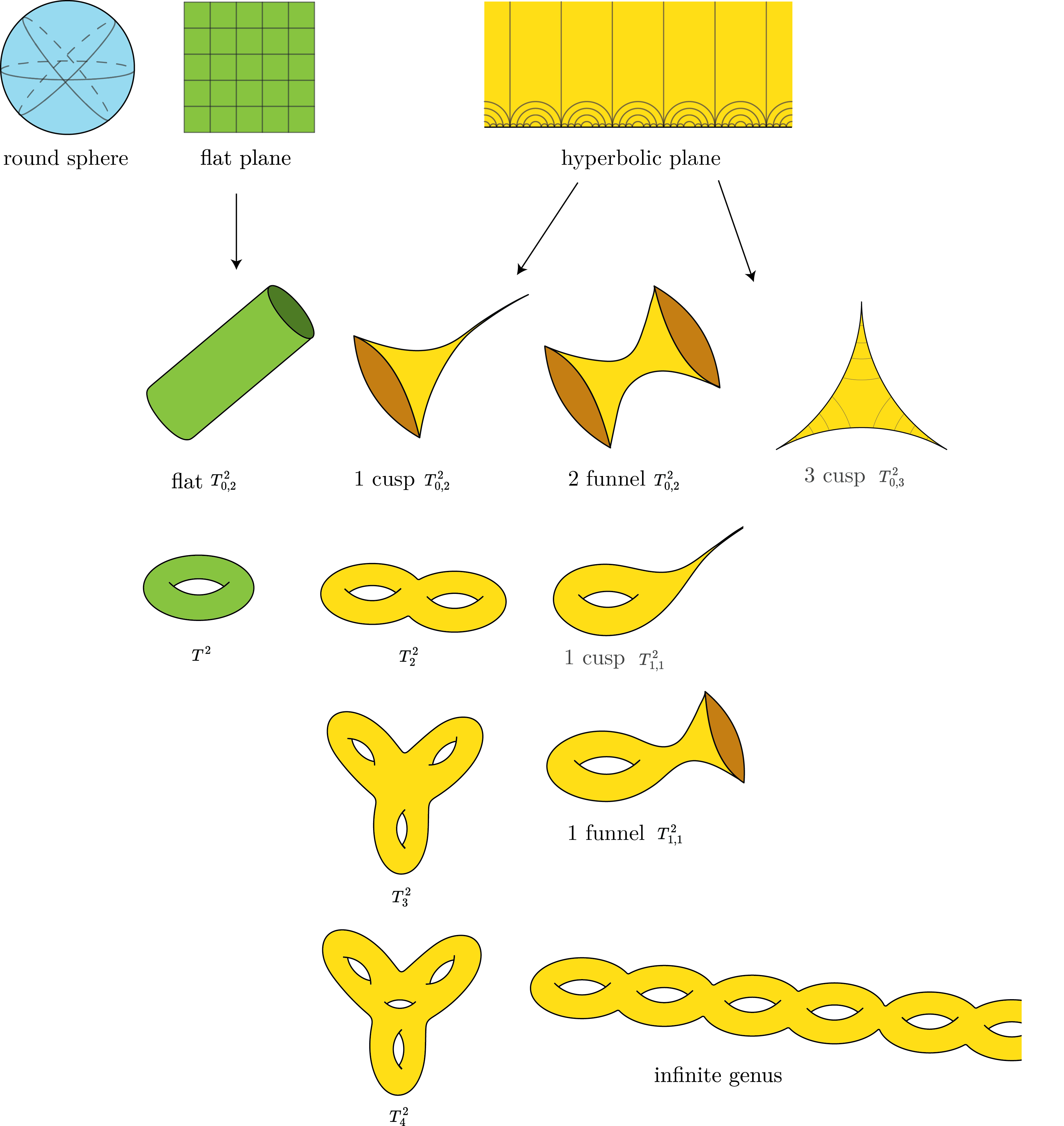
lecture videosThese lectures assume covering space theory (algebraic topology) and uniformization theory and does (pre-moduli space) classification of Riemann surfaces: https://www.youtube.com/playlist?list=PLbMVogVj5nJSm4256vuITlsovUT1xVkULRiemann surfaces which are quotients of the unit disk by torsion free Fuchsian groups are biholomorphic if and only if the Fuchsian groups are conjugate inside the automorphism group of the unit disk. Oriented hyperbolic surfaces (connected, complete Riemannian 2-manifolds of constant sectional curvature -1) are also quotients of the unit disk by torsion free Fuchsian groups, with oriented isometries related to conjugacies. Therefore we may study, even classify Riemann surfaces through the theory of oriented hyperbolic surfaces.
The space of all marked Riemann surfaces of genus
is called Teichmuller space of genus Riemann surfaces. These spaces are complex manifolds of dimension depending on the genus . Link to original
bookFarb Margalit - Mapping class groups
several complex variables and complex manifolds
lecture noteshttps://agag-jboehm.math.rptu.de/~boehm/lehre/21_CM/cm.pdflecture notesLecture Notes by Zbigniew Błockilecture noteshttps://www.math.stonybrook.edu/~cschnell/pdf/notes/complex-manifolds.pdf from https://www.math.stonybrook.edu/~cschnell/mat545/- https://www.math.stonybrook.edu/~cschnell/pdf/notes/abelian-varieties.pdf
lecture noteshttps://www.jirka.org/scv/scv.pdfbookFrom Holomorphic Functions to Complex Manifolds | Springer Nature Linklecture noteshttps://enric-sf.github.io/courses/CG/CG_ln.pdf from https://enric-sf.github.io/courses/CG/complex_geometry.htmlbookHerbert Alexander, John Wermer - Several Complex Variables and Banach AlgebrasbookJoseph L Taylor - Several complex variables with connections to algebraic geometry and Lie groupsbookLars Hörmander - An Introduction to Complex Analysis in Several Variables, 3rd Edition (1990)lecture videosPierre Albin - Math 514: Complex Algebraic Geometry - Fall 2020lecture videosHans-Joachim Hein - Complex Geometry- Prerequisites: Basics of manifolds, tensor fields, differential forms, etc. Warner, Foundations of Differentiable Manifolds and Lie Groups, Chapters 1, 2, 4, 6, contains all we need and much more.
- Basic complex analysis as in Stein & Shakarchi, Complex Analysis, Chapters 1, 2, 3, 8.
- Reading:
- Huybrechts, Complex Geometry, is an excellent basic textbook with exercises.
- Lecture notes by Joel Fine: http://homepages.ulb.ac.be/∼joelfine/papers.html#survey.
- Complex Monge-Ampere: http://gamma.im.uj.edu.pl/∼blocki/publ/ln/tln.pdf.
- For the end of Week 2: http://arxiv.org/pdf/0803.0985.pdf, Section 5.
- Week 1: Introduction to Complex Geometry
- Holomorphic Functions and Complex Calculus
- Complex Manifolds
- Holomorphic Line Bundles
- Pseudoconvexity and Pseudoconcavity
- The Kodaira Embedding Theorem
- Week 2: Topics in Kahler-Einstein Manifolds
- Kahler Manifolds
- Ricci Curvature and the Complex Monge-Ampere Equation
- Examples of Ricci-flat Spaces
- Basic Estimates for the Complex Monge-Ampere Equation
- The Mukai-Umemura Manifold
Riemannian geometry
A second course in Riemannian geometry is of fashion.
lecture videosTopics in Geometry and Topology: A Second Course in Riemannian Geometry - Fields Academy Shared Graduate Course
We can specifically look at Ricci flows!
lecture videosGerhard Huisken - Ricci flowarticleRichard H Bamler - Recent developments in Ricci flows
The fields of spectral geometry and geometric analysis are very interesting!
lecture videosMasoud Khalkhali - Spectral geometrybookOlivier Lablée - Spectral Theory in Riemannian Geometrylecture videosAaron Naber - Geometric Analysis- Prerequisites: Basics of manifolds, tensors, and differential forms. Basics of PDE theory, for instance Evans’s book Partial Differential Equations, in particular those chapters on second order elliptic and parabolic equations. Familiarity with exponential maps, injectivity radius, and geodesics would be helpful, for instance chapter one of Jost’s book Riemannian Geometry and Geometric Analysis is more than sufficient.
- Reading: The main source will be Petersen’s book on Riemannian Geometry. We will also rely on Jost’s Riemannian Geometry and Geometric Analysis, and on the book by Cheeger Degeneration of Riemannian Metrics Under Ricci Curvature Bounds. More advanced topics will use relevant papers in the field.
- Week 1: Introduction to Geometric Analysis
- Review of Manifolds and Smooth Structure
- Introduction to Curvature and Geodesic Coordinates
- Laplacians and Harmonic Coordinates
- Heat Kernels and Geometry
- Sectional Curvature and Finite Diffeomorphism Theorems
- Week 2: Topics in Regularity Theory
- Ricci Curvature, Volume Monotonicity and Rigidity Theorems
- Ricci Curvature and Almost Rigidity Theorems
- Lower Ricci Curvature and Stratification Theorems
- Bounded Ricci Curvature and ε-regularity Theorems
- Outline of Regularity Theory for Einstein Manifolds
lecture videos【MIT数学课程】 流形上的几何:18.966 Geometry of Manifolds Ⅱ 2021 Spring_哔哩哔哩_bilibili- More about this course at course-mit18.96x-geometry
- MAT 6229: Geometric spectral theory | Institut des sciences mathématiques
We may also look at some Kahler geometry.
abstract harmonic analysis, operator theory
bookFolland - Abstract harmonic analysis
Transclude of inculcation-lie-groups#banach-algebras-c--algebras
analytic group theory
lecture notes[2402.15867v1] An Invitation to Analytic Group Theory
Algebraic geometry
Well…
V
symmetric spaces, semisimple Lie groups, their unitary representations and discrete subgroups
We look at locally symmetric spaces and correspondingly discrete subgroups of semisimple Lie groups: their deformations and phenomenon of rigidity. We have Mostow’s strong rigidity.
Lie groups, symmetric spaces and beyond
Link to original
- A guide through the theory of symmetric spaces
- Programa de Doutorado: Lie Groups, Representation Theory and Symmetric Spaces - YouTube
- Muna Naik - Riemannian Symmetric Space
- Homogeneous Dynamics and Geometry in Higher-Rank Lie Groups - YouTube
- Discrete subgroups of Lie groups - YouTube
- Rigidity - FRH - YouTube
- there’s some notes in Alp Uzman’s Webpage
large events
Link to original
- Geometry, Groups and Dynamics (GGD) - 2017 | ICTS
- Harish-Chandra & Centenary Celebrations at HRI
- The year-long program on Harish-Chandra’s birth centenary - YouTube
global, microlocal, infinite dimensional analysis
lecture videosMIT 18.157 Microlocal Analysis Spring 2021lecture videosMicrolocal Analysis - 2021 Fall, Peter Hintz (ETH Zürich)lecture notesSemiclassical Microlocal Analysislecture notes18.157: Introduction to Microlocal Analysislecture videosTMS 2018 Spring: An introduction to Geometric Measure Theory
nilpotent Lie groups and their unitary representations
number theory
low dimensional topology and geometry
lecture videosIntroduction to Knot Theory and 3-manifold Topology - YouTubelecture videosMT855F20: Low-dimensional topology and the Casson invariant
dynamics and rigidity
locally symmetric spaces of higher rank and hyperbolic manifolds in higher dimensions
symplectic topology
listFloer homologyworkshop,talk videosWorkshop on Hamiltonian Geometry and Quantization | Fields Institute for Research in Mathematical Scienceslecture videosFukaya categories and mirror symmetry
algebraic curves and Riemann surfaces, moduli and Teichmuller spaces
3
We can consider the algebraic perspective to Riemann surfaces.
talkAlgebraic Curves and Belyi’s theorem by Anand Deopurkar - YouTubelecture videosMAT 670: Topics in Complex Analysis: Dessins and Dynamics (introduction to quasiconformal folding)We may define a weaker notion of isomorphism of Riemann surfaces: quasiconformal homeomorphism. The class of marked Riemann surfaces quasiconformal to a fixed Riemann surface generalise the Teichmuller space of compact Riemann surfaces.
bookHubbard - Teichmuller theory volume 1A hyperbolic surface comes with its Laplacian. We may study its spectrum and eigenfunctions and ask interesting questions!
bookGeometry and Spectra of Compact Riemann Surfaces - Google Booksbookarithmetic quantum unique ergodicitylecture videosChristopher Bishop - MAT 638: Topics in Real Analysis: Weil-Petersson curves, traveling salesman theorems, and minimal surfaces, Fall 2020We may study the spectral theory of modular surfaces and extract number theoretic facts.
paperhttps://web.math.princeton.edu/~sarnak/Preprints/baltimore.pdflecture notesLectures on Diophantine approximation and DynamicsWe can ask questions about moduli of Riemann surfaces, such as its spectra as genus goes to infinity and so on.
We can compactify the moduli space.
Link to original
VI
- https://mathtube.org/
- https://www.carmin.tv/en/
- https://www.math.stonybrook.edu/videos/
- https://www.birs.ca/videos/
- https://video-archive.fields.utoronto.ca/
- https://www.youtube.com/@nctsmathdivision9695/playlists
- https://www.youtube.com/@workshopingeometrictopolog8344/playlists
- https://www.youtube.com/@institutfourier/playlists
- https://www.youtube.com/@mathematicsathse1021/playlists
- https://www.youtube.com/@nationalcentreformathemati3331/playlists
- https://www.youtube.com/@impabr/playlists
- https://www.youtube.com/@FieldsInstitute/playlists
- https://www.mpim-bonn.mpg.de/search/node/video